Ryan Drummond asked, Why the ocean?
The ocean is the only earthly environment which man cannot overpower, the ocean belittles man.
“...our tools are always deployed in the service of some philosophy or ideology. If we are to use our tools in the service of fitting in on Earth, our basic relationship to nature- even the story we tell ourselves about who we are in the universe has to change.” _Janine Benyus
Water in this context is a mechanism, and the architecture; an experiential tool. The power and scale-less immensity of the ocean challenges human significance. The ocean transforms social structure. Community is necessitated by man’s inability to control the force of the sea.
On interdisciplinary exploration (informational systems integration) :
"...in the fertile crests between intellectual habitats. Where ecology meets agriculture, medicine, materials science, energy, computing, [architecture,] and commerce, they are learning that there is more to discover than to invent." _Janine Benyus
3.23.2008

3.04.2008
Program Phase 01
Population Data_
Researchers_ 25
Family_ 45
Staff_ 20
Module Data_
A Module =45.3’ Module ≈5 levels ≈10,000 square feet
B Module =28’ Module ≈2 levels ≈1,500 square feet
C Module =17.6’ Module ≈2 levels ≈500 square feet
Solo Module =6.6’ Module =1 person
Topside Level_ 22 modules + 125 units
Recreational Landscape_ 3 A modules
Multi-sport Courts_ 2 A modules
Community Space_ 3 B modules
Exercise Space_ 2 B modules
Restaurant_ B module
Bathrooms / Maintenance_ Integrated
Atmospheric Laboratory_ 2 B modules
Radio + Communications Center_ B module
Solar Desalinization Units_ 100 units (one per capita)
Induction Wind Turbines_ 25 units (1/4 per capita)
Solo Pods_ 8 Solo modules
Volatile Level_ 12 modules
Main Leeward Port Entrance_ B module
Secondary Escape Port_ B module
Floating / Submersible Platform Landscape_ 10 B modules
Bathrooms / Maintenance_ Integrated
Coral Level_ 38 modules
Housing Units_ 12 B modules
Bathrooms_ Integrated
Experiment Frameworks_ 5 C modules
Sample Traps_ Integrated
Coral ‘Moonpool’ Laboratory_ Integrated
Decompression Chambers_ 2 C modules
Dry Specimen Laboratory_ 2 C modules
Community Space_ 2 B modules
Bathrooms / Maintenance_ Integrated
Restaurant_ B module
Movie Theatre_ C module
Public Computer Center / Server_ B module
Solo Pods_ 12 Solo modules
150-200m_ 25 units
Current Driven Turbines_ 25 Units (1/4 per capita)
300m Level_ 13 modulesSaturated Dive Laboratory_ B module
Decompression Chambers_ 2 C modules
Robotics Control Laboratory_ C module
Restaurant_ B module
Bathrooms / Maintenance_ Integrated
Computer Lab_ C moduleMovie Theatre_ C module
Seafloor Level_ 1 module
Uninhabited AUV + Submersible Charge Port_ B Module
Data Port_ Integrated
Sample Receptacle + Lift_ Integrated
Vertical Circulation_ 8 units
Buoyancy Elevators_ 2 units
Infrequent Non-Volatile Carbon Tendon Shuttles_ 3 units
Construction + Maintenance Cranes + Ports_ 3 units
External_
Kelp + Algae Growth Pods_ 100 units (1 per capita)
Fish Farm + Collection Pods_ 50 units (1/2 per capita)
Wave Energy Generation Buoys_ 25 units (1/4 per capita)
Researchers_ 25
Family_ 45
Staff_ 20
Module Data_
A Module =45.3’ Module ≈5 levels ≈10,000 square feet
B Module =28’ Module ≈2 levels ≈1,500 square feet
C Module =17.6’ Module ≈2 levels ≈500 square feet
Solo Module =6.6’ Module =1 person
Topside Level_ 22 modules + 125 units
Recreational Landscape_ 3 A modules
Multi-sport Courts_ 2 A modules
Community Space_ 3 B modules
Exercise Space_ 2 B modules
Restaurant_ B module
Bathrooms / Maintenance_ Integrated
Atmospheric Laboratory_ 2 B modules
Radio + Communications Center_ B module
Solar Desalinization Units_ 100 units (one per capita)
Induction Wind Turbines_ 25 units (1/4 per capita)
Solo Pods_ 8 Solo modules
Volatile Level_ 12 modules
Main Leeward Port Entrance_ B module
Secondary Escape Port_ B module
Floating / Submersible Platform Landscape_ 10 B modules
Bathrooms / Maintenance_ Integrated
Coral Level_ 38 modules
Housing Units_ 12 B modules
Bathrooms_ Integrated
Experiment Frameworks_ 5 C modules
Sample Traps_ Integrated
Coral ‘Moonpool’ Laboratory_ Integrated
Decompression Chambers_ 2 C modules
Dry Specimen Laboratory_ 2 C modules
Community Space_ 2 B modules
Bathrooms / Maintenance_ Integrated
Restaurant_ B module
Movie Theatre_ C module
Public Computer Center / Server_ B module
Solo Pods_ 12 Solo modules
150-200m_ 25 units
Current Driven Turbines_ 25 Units (1/4 per capita)
300m Level_ 13 modulesSaturated Dive Laboratory_ B module
Decompression Chambers_ 2 C modules
Robotics Control Laboratory_ C module
Restaurant_ B module
Bathrooms / Maintenance_ Integrated
Computer Lab_ C moduleMovie Theatre_ C module
Submersible Dry Port_ B module
Solo Pods_ 5 Solo ModulesSeafloor Level_ 1 module
Uninhabited AUV + Submersible Charge Port_ B Module
Data Port_ Integrated
Sample Receptacle + Lift_ Integrated
Vertical Circulation_ 8 units
Buoyancy Elevators_ 2 units
Infrequent Non-Volatile Carbon Tendon Shuttles_ 3 units
Construction + Maintenance Cranes + Ports_ 3 units
External_
Kelp + Algae Growth Pods_ 100 units (1 per capita)
Fish Farm + Collection Pods_ 50 units (1/2 per capita)
Wave Energy Generation Buoys_ 25 units (1/4 per capita)
Pre-Jury-Jury Reactions
I apologize to all for leaving but it was an emergency or I would not have left. I'm very glad we had this pre-jury-jury and I wish I could have seen the others because I think we're really gaining momentum and showing direction. I have been designing too much in my head still, being too careful to make everything presentable and as a result I haven't gotten to the models and perspectives which make this a real project to the jurors. I also need to clearly outline what the physical pragmatic constraints of underwater construction / architecture are. Andrew pointed out that this can be very straight forward and because the experiential aspects are entirely different. I feel that this relates to the dual nature of this project that has interested me all along and will help me show that I intend to merge the performative engineering side with the experiential poetics to create the architecture. This poetic experience however cannot be realized without a narrative. In addition to experience this gives the dimensions of the modules legitimacy showing that they can indeed fit the program in a comfortable way.
The scribble of a site plan, program level-list, and repair maintenance robotics will be enlarged and clarified for thursday along with the narrative perspectives. As Lisa pointed out it is better to show the best example of each system rather than working out the entire project to a lesser degree. In that line of thought, the perspective become a background for overlaying the information (plan, section, detail, 3D view) about each module which facilitates that experience. Hopefully with the jury upcoming we can discuss which parts of the project hold the most potential for being taking to larger scales and worked out in more detail.
Narrative Perspectives for Thursday: Surface Port Entry> Main Coral Level Lobby / Divers> Topside Courtyard> Housing Unit> Deep Laboratory> Solo Cathedral Pod
Also the NOAA's (National Oceanic and Atmospheric Association) IOOS (Integrated Ocean Observing System) Diagram which I forgot to present last night will help put this in a scientific context.
The overall structure of the presentation can then be first pragmatic and then the experiential one of the user and follow the narrative I have layed out above. Perfomance + Experience as Design + Affect.
The scribble of a site plan, program level-list, and repair maintenance robotics will be enlarged and clarified for thursday along with the narrative perspectives. As Lisa pointed out it is better to show the best example of each system rather than working out the entire project to a lesser degree. In that line of thought, the perspective become a background for overlaying the information (plan, section, detail, 3D view) about each module which facilitates that experience. Hopefully with the jury upcoming we can discuss which parts of the project hold the most potential for being taking to larger scales and worked out in more detail.
Narrative Perspectives for Thursday: Surface Port Entry> Main Coral Level Lobby / Divers> Topside Courtyard> Housing Unit> Deep Laboratory> Solo Cathedral Pod
Also the NOAA's (National Oceanic and Atmospheric Association) IOOS (Integrated Ocean Observing System) Diagram which I forgot to present last night will help put this in a scientific context.
The overall structure of the presentation can then be first pragmatic and then the experiential one of the user and follow the narrative I have layed out above. Perfomance + Experience as Design + Affect.
2.17.2008
Abstract 01
Systemic Integration:
Architecture in its current state is isolated because it does not recognize itself as an adaptive system within a larger constantly evolving network. Subtractive, analytical processes serve to isolate the subject from the very factors which define them, while systemic processes derive order from cooperative interaction with dynamic systems.
Systemic integration is a way of understanding and evolving the connections between systems which have previously been understood as singular elements. This thesis specifically explores the relationship between water and architecture to develop a connection with the ocean as an environment to be understood and experienced.
The existing structures of oil platforms in the Gulf of Mexico provide a framework to which an architectural system can be applied to initiate this investigation. The oil platform as it exists currently is exclusively industrial and does not relate to the oceanic context but draws only from the oil reserves beneath the sea floor. To the oil company; when the reserves are dry, so ends the life of the platform. Thinking about this structural system as a part of a network allows performative and experiential systems to be designed for and integrated into the existing network.
This thesis explores how architecture can be designed through a process of compositing informational systems, which then informs the design network, which becomes the architecture. The architecture within this context is never complete but is continuously responsive to the dynamic network of which it is a system.
240 words.
Architecture in its current state is isolated because it does not recognize itself as an adaptive system within a larger constantly evolving network. Subtractive, analytical processes serve to isolate the subject from the very factors which define them, while systemic processes derive order from cooperative interaction with dynamic systems.
Systemic integration is a way of understanding and evolving the connections between systems which have previously been understood as singular elements. This thesis specifically explores the relationship between water and architecture to develop a connection with the ocean as an environment to be understood and experienced.
The existing structures of oil platforms in the Gulf of Mexico provide a framework to which an architectural system can be applied to initiate this investigation. The oil platform as it exists currently is exclusively industrial and does not relate to the oceanic context but draws only from the oil reserves beneath the sea floor. To the oil company; when the reserves are dry, so ends the life of the platform. Thinking about this structural system as a part of a network allows performative and experiential systems to be designed for and integrated into the existing network.
This thesis explores how architecture can be designed through a process of compositing informational systems, which then informs the design network, which becomes the architecture. The architecture within this context is never complete but is continuously responsive to the dynamic network of which it is a system.
240 words.
2.13.2008
Quarter Jury
I was immediately thrown off by the juror's question about my position on systems thinking. I think my case studies from last semester would have been helpful in stating my position and creating architectural strategies which relate to the systemic architectural process. I think this unclear stance on systems and the difference between systemic v. systematic negated the architectural ideas about experience, program, displacement and construction which i thought the jury was going to be about. Instead of taking in the juror's comments I was trying to defend ideas that I wasn't expecting to defend. If you have any comments and ideas that were mentioned I'd appreciate if you could re-state those for me.
I think the jurors understood the idea that it was a growing and biological concept and the DNA reference as it applied to other oil platforms and programs. One juror even questioned the twin duplication of architecture on separate but identical platforms.
Some Points:
Clarify and Define Systems thinking; Systemic v. Systematic:
Systematic: Done or acting according to a fixed plan or system.
Systemic: Of or relating to a system, especially as opposed to a particular part
Use Case Studies to illustrate Systemic Devices + Explore and Diagram design process to serve as framework for Systemic Architectural Design Process
Clarify Quotes for possible interpretation.
Extend the architectural DNA to other rigs and programs to exemplify the systemic nature and process of the architecture.
I think the jurors understood the idea that it was a growing and biological concept and the DNA reference as it applied to other oil platforms and programs. One juror even questioned the twin duplication of architecture on separate but identical platforms.
Some Points:
Clarify and Define Systems thinking; Systemic v. Systematic:
Systematic: Done or acting according to a fixed plan or system.
Systemic: Of or relating to a system, especially as opposed to a particular part
Use Case Studies to illustrate Systemic Devices + Explore and Diagram design process to serve as framework for Systemic Architectural Design Process
Clarify Quotes for possible interpretation.
Extend the architectural DNA to other rigs and programs to exemplify the systemic nature and process of the architecture.
2.09.2008
Added.
I've added some quotes on the side bar as well as i wanted to share these drawings I was refered to that i would like to use as reference for my own process and presentation. These drawings aren't singular but contain layered and composed elements or systesms of information from many different mediums and types of studies in conjunction with reference material to support the process of each study. The process systems are composed into a network of information. http://www.1-ab.com/kulper.htm


1.30.2008
New Schedule
Break:
Redefine Theory.
Schedule
Digital Site Model
Programmatic Diagrams
Case Studies: Salk Institute, Mobius House, Yokohama International Terminal
Basic Dimensional Information for Models
1/8_
1 Stewardson Competition
2 PARTI and Site Analysis
Quarter Jury 2/8 DESIGN PARTI
Parti: SPATIAL + PROGRAMMATIC
1 Develop conceptual systems diagrams (1= diagrams)
2 Create presentation site sections in autoCAD to draw over synthesis drawing
conceptual model (scale 1"=100' (tentative)) for gestural, spatial and programmatic relationships
experiential / spatial perspectives with superimposed plan and sectional information
Update Thesis Document
3/8_
MATERIAL + TECTONIC
1 develop tectonic language + materials
2 Module + Module Connection Sections
mid jury 4/8 SCHEMATIC DEVELOPMENT OF PARTI
REPRESENT EXPERIENCE + TRANSFORMATION
1 Mapping integrated informational network of Oilrigs in Gulf of Mexico
2 Update Thesis Document
5/8_
1 merges and perspectives
2 Update + Design Final Thesis Document
3Quarter JURY 6/8_ DETAILED DESIGN DEVELOPMENT
1 REFINE SMALL SCALE: Module Model @ 8th Scale
2THESIS DOCUMENT DUE
7/8
1 Format Final Presentation:
Scale Previous Drawings
Large format hand drawn Transformational sections over AutoCAD Drawings
refine + develop previous drawings
2 1/4" scale details +
experience perspectives
8/8 final jury_
1 Final Model Prep: Welding + more experience perspectives
2 FINAL MODEL + Presentation Idea
Large Scale Section model or Entire Tower Welded + Intervention
Rig=1900’ = 19” @ 100th = 1.5’
=38” @ 50th = 2.1’
=43” @ 32nd = 3.7’
=76” @ 25th = 6.3’
Section=500’= 5” @ 100th = .45’
=10” @ 50th = .8’
=41.6” @ 12th = 3.5’
Module= TBD
Redefine Theory.
Schedule
Digital Site Model
Programmatic Diagrams
Case Studies: Salk Institute, Mobius House, Yokohama International Terminal
Basic Dimensional Information for Models
1/8_
1 Stewardson Competition
2 PARTI and Site Analysis
Quarter Jury 2/8 DESIGN PARTI
Parti: SPATIAL + PROGRAMMATIC
1 Develop conceptual systems diagrams (1= diagrams)
2 Create presentation site sections in autoCAD to draw over synthesis drawing
conceptual model (scale 1"=100' (tentative)) for gestural, spatial and programmatic relationships
experiential / spatial perspectives with superimposed plan and sectional information
Update Thesis Document
3/8_
MATERIAL + TECTONIC
1 develop tectonic language + materials
2 Module + Module Connection Sections
mid jury 4/8 SCHEMATIC DEVELOPMENT OF PARTI
REPRESENT EXPERIENCE + TRANSFORMATION
1 Mapping integrated informational network of Oilrigs in Gulf of Mexico
2 Update Thesis Document
5/8_
1 merges and perspectives
2 Update + Design Final Thesis Document
3Quarter JURY 6/8_ DETAILED DESIGN DEVELOPMENT
1 REFINE SMALL SCALE: Module Model @ 8th Scale
2THESIS DOCUMENT DUE
7/8
1 Format Final Presentation:
Scale Previous Drawings
Large format hand drawn Transformational sections over AutoCAD Drawings
refine + develop previous drawings
2 1/4" scale details +
experience perspectives
8/8 final jury_
1 Final Model Prep: Welding + more experience perspectives
2 FINAL MODEL + Presentation Idea
Large Scale Section model or Entire Tower Welded + Intervention
Rig=1900’ = 19” @ 100th = 1.5’
=38” @ 50th = 2.1’
=43” @ 32nd = 3.7’
=76” @ 25th = 6.3’
Section=500’= 5” @ 100th = .45’
=10” @ 50th = .8’
=41.6” @ 12th = 3.5’
Module= TBD
12.11.2007
Schedule
december 13-18_
this time will be spent in NYC around the site collecting physical data as well as beginning photographing and mapping the site in the way described in the previous post. Gonna try to get on some roof tops.
december 18- january 22_
expanding narrative about NYSea
sketches, altered images, site merges
collecting maps
Update Thesis Document
quarter 1_
develop conceptual systems relation and spatial language
create presentation site diagrams (based on site sketches) and synthesis drawing
conceptual model including context and highline (scale 1"=64' (tentative)) for gestural, spatial and programmatic development
experiential / spatial perspectives with superimposed plan and sectional information
Update Thesis Document
mid point_
develop tectonic language
shell model at 1"=16' scale
mappings of integration phase 2 immediate scale of highline based on determined strategies
begin to sketch and find potential places for integration phase 3: manhattan e.i. times square, chinatown
Update Thesis Document
quarter 3_
refine
shell model 1"=8' scale
apply as strategy or DNA
mappings of integration phase 3: manhattan
merges and perspectives of chosen sites
Update + Design Final Thesis Document
final jury_
1/4" scale details + experience model
mappings of integrated NYSea
refine + develop previous drawings
this time will be spent in NYC around the site collecting physical data as well as beginning photographing and mapping the site in the way described in the previous post. Gonna try to get on some roof tops.
december 18- january 22_
expanding narrative about NYSea
sketches, altered images, site merges
collecting maps
Update Thesis Document
quarter 1_
develop conceptual systems relation and spatial language
create presentation site diagrams (based on site sketches) and synthesis drawing
conceptual model including context and highline (scale 1"=64' (tentative)) for gestural, spatial and programmatic development
experiential / spatial perspectives with superimposed plan and sectional information
Update Thesis Document
mid point_
develop tectonic language
shell model at 1"=16' scale
mappings of integration phase 2 immediate scale of highline based on determined strategies
begin to sketch and find potential places for integration phase 3: manhattan e.i. times square, chinatown
Update Thesis Document
quarter 3_
refine
shell model 1"=8' scale
apply as strategy or DNA
mappings of integration phase 3: manhattan
merges and perspectives of chosen sites
Update + Design Final Thesis Document
final jury_
1/4" scale details + experience model
mappings of integrated NYSea
refine + develop previous drawings
12.10.2007
Integration Process
This thesis seeks to explore a systematic design process as a means of integrating architecture into a dynamic context as an integral system rather than an isolated feature.

Diagramming the new order of pauses, flows, interaction and disinterest, will establish an organization for the site. This will include layers of interaction to decide the placement and appropriate relation of program in terms of public and private. This diagramming exercise is not only to take place on one level but must consider the three dimensional matrix, underwater, dynamic water surface, highline and skyline. Sectional diagrams also consider the interrelation of the layers.
The system must acknowledge the program that was, the current uses and the program which can be implemented to affect the experience and function of the place in the future. This three dimensional mapping creates the spatial and structural framework for the intervention which is interpreted and synthesized into the site. The integration is both additive and subtractive to the existing matrix and also must consider its future position.
Erosion is an example of a three dimensional space making process which relates form to hydrodynamics or more generally, forces, as well as material obsolescence. Allowing erosion to become an active participant in organization and post occupancy re-organization of form and space allows architecture to become integrated with the underlying order of information, energy and matter. The system then must be tested by the Post-Industrial concepts to keep from falling into symptomatic default reactions.

The highline shell project establishes a process and a strategy from which the architectural network can grow as a biological system. The highline rail system is utilized as a vein for expansion while other affected and activated veins of the city will be identified or created. The physical language of the architecture is determined by the immediate context of the site and the inherent voice of the program. Consequently, the resultant tectonic systems may differ drastically from one another even though they stem from the same process and architectural strategies.

Diagramming the new order of pauses, flows, interaction and disinterest, will establish an organization for the site. This will include layers of interaction to decide the placement and appropriate relation of program in terms of public and private. This diagramming exercise is not only to take place on one level but must consider the three dimensional matrix, underwater, dynamic water surface, highline and skyline. Sectional diagrams also consider the interrelation of the layers.
The system must acknowledge the program that was, the current uses and the program which can be implemented to affect the experience and function of the place in the future. This three dimensional mapping creates the spatial and structural framework for the intervention which is interpreted and synthesized into the site. The integration is both additive and subtractive to the existing matrix and also must consider its future position.
Erosion is an example of a three dimensional space making process which relates form to hydrodynamics or more generally, forces, as well as material obsolescence. Allowing erosion to become an active participant in organization and post occupancy re-organization of form and space allows architecture to become integrated with the underlying order of information, energy and matter. The system then must be tested by the Post-Industrial concepts to keep from falling into symptomatic default reactions.

The highline shell project establishes a process and a strategy from which the architectural network can grow as a biological system. The highline rail system is utilized as a vein for expansion while other affected and activated veins of the city will be identified or created. The physical language of the architecture is determined by the immediate context of the site and the inherent voice of the program. Consequently, the resultant tectonic systems may differ drastically from one another even though they stem from the same process and architectural strategies.
The Highline Shell
Water + Architecture_
Sea level rise is an event which cannot be met symptomatically. In the past, engineers have built dikes and levees to hold back water from civilizations only to prolong the inevitable interaction between water and architecture. Hurricane Katrina is one of many instances that illustrate the dangerous consequences of controlling rather than cooperating with nature.
Architecture has not addressed water and so now it is being forced upon us. New Orleans, Bangladesh and the United Kingdom are only a few examples of the regions being inundated by the forces of water.
The systematic paradigm suggests that water in this context is not a misfortune, rather a means to enhance experience, redefine space and consider the inhabitation of the edge of our land bound world. More than seventy percent of the globe is covered with water yet it remains fundamentally ignored for its resources and remains almost completely barren of human inhabitation.
NYSea Site + Systems_
This is an architectural thesis and in order to avoid complicating issues, such as the political aftermath of a disaster, this project will propose its own hypothetical scenario in which sea levels have risen twenty three feet. The map illustrates, in dark blue, the areas which would be submerged by the waters. This level of coverage does not completely debilitate the city but does cut off its most important transportation systems, automobiles and the subway.


Sea level rise is an event which cannot be met symptomatically. In the past, engineers have built dikes and levees to hold back water from civilizations only to prolong the inevitable interaction between water and architecture. Hurricane Katrina is one of many instances that illustrate the dangerous consequences of controlling rather than cooperating with nature.
Architecture has not addressed water and so now it is being forced upon us. New Orleans, Bangladesh and the United Kingdom are only a few examples of the regions being inundated by the forces of water.

The systematic paradigm suggests that water in this context is not a misfortune, rather a means to enhance experience, redefine space and consider the inhabitation of the edge of our land bound world. More than seventy percent of the globe is covered with water yet it remains fundamentally ignored for its resources and remains almost completely barren of human inhabitation.
NYSea Site + Systems_
This is an architectural thesis and in order to avoid complicating issues, such as the political aftermath of a disaster, this project will propose its own hypothetical scenario in which sea levels have risen twenty three feet. The map illustrates, in dark blue, the areas which would be submerged by the waters. This level of coverage does not completely debilitate the city but does cut off its most important transportation systems, automobiles and the subway.

At the edge of the partially drowned megalopolis there exists a shell of a building in the northwest corner of the West Village. The remains of industry long since gone but not yet reclaimed by developers. Through the shell the highline erodes a massive void which now pumps life back into the structure. The highline was informally reinstated by the risen water level. The train no longer runs, but activity is forced onto its raised level, the familiar, somewhat solid ground connecting to higher, dryer parts of the Manhattan in the north. What once was the only empty building in the neighborhood now is now reanimated.
High fashion boutiques and night clubs are now flooded; only the higher residential levels remain inhabited. Fire exits turned into main entrances bring a mischievous experience to even mundane places. Roof tops are now a landscape, as separate as they might be, connecting people. The roof which used to be the most private space in the city now has become the most public, event formed transformation.
The bay, once far from mind, now seems such a viable option for conversation and relaxation. Soon those who stayed realized that a sail boat is a far more versatile tool than a car, it is a mobile place not simply a vehicle. Water familiarized interaction with the forgotten layers of the city and extended the borders of interaction well into the bay. Most of all the speed of the city was altered, and the journey became as significant as the destination.
High fashion boutiques and night clubs are now flooded; only the higher residential levels remain inhabited. Fire exits turned into main entrances bring a mischievous experience to even mundane places. Roof tops are now a landscape, as separate as they might be, connecting people. The roof which used to be the most private space in the city now has become the most public, event formed transformation.
The bay, once far from mind, now seems such a viable option for conversation and relaxation. Soon those who stayed realized that a sail boat is a far more versatile tool than a car, it is a mobile place not simply a vehicle. Water familiarized interaction with the forgotten layers of the city and extended the borders of interaction well into the bay. Most of all the speed of the city was altered, and the journey became as significant as the destination.


[The shell in these images is the black square structure superimposed over the highline railway. It lies on 14th street a main east-west corridor. The historic Chelsea district lies to the north and the bay was once to the west. The shell is on the right in the bottom images]


Paradigms of Thought
Industrial Establishment vs. Post-Industrial Establishment
Planning:
Anthropocentric cosmology / Biocentric cosmology
Linear Production / Cyclical Flows
Short Term Plan / Long Term Plan
Incremental Shifts / Continuous Change
Practice:
Product and Tradition Oriented / Process and discipline oriented
Local effects of action / Global effects of interaction
Mechanistic relationships / Systemic relationships
Heuristic procedures / Cybernetic integration
Design:
Hierarchical and linear / Holistic and non-linear
Embrace deterministic simplicity / Embrace teleological complexity
Anticipate the inevitable future / Design for future scenarios
Manual and automatic control / Intelligent Automation
Transient static solutions / Robust dynamic solutions
Leonard Bachman outlines these concepts as a part of his essay entitled, "Post Industrial Architecture, Dynamic Complexity, and the Emerging Principles of Strategic Design"
These concepts give a framework by which a systematic intervention can be created and evaluated.
Planning:
Anthropocentric cosmology / Biocentric cosmology
Linear Production / Cyclical Flows
Short Term Plan / Long Term Plan
Incremental Shifts / Continuous Change
Practice:
Product and Tradition Oriented / Process and discipline oriented
Local effects of action / Global effects of interaction
Mechanistic relationships / Systemic relationships
Heuristic procedures / Cybernetic integration
Design:
Hierarchical and linear / Holistic and non-linear
Embrace deterministic simplicity / Embrace teleological complexity
Anticipate the inevitable future / Design for future scenarios
Manual and automatic control / Intelligent Automation
Transient static solutions / Robust dynamic solutions
Leonard Bachman outlines these concepts as a part of his essay entitled, "Post Industrial Architecture, Dynamic Complexity, and the Emerging Principles of Strategic Design"
These concepts give a framework by which a systematic intervention can be created and evaluated.
12.05.2007
Integrated: Fallingwater
Fallingwater has a structural system based on the logic found in the surrounding rock walls, their erosion and inhabitation, to create space. The masonry core supports the cantilevered reinforced concrete trays which extend the user into the outdoors. The connection between the stone core and outdoor extensions is where the interior spaces form and the stone is sculpted and supplemented by a system of built-in wooden amenities to integrate function and movement. The trays relationships to each other creates interaction within the architecture itself while also removing the user from the architecture allowing them to engage with nature from the perspective of a squirrel amongst the trees.


Fallingwater's reaction to the landscape creates dynamic relationships between form and space, which can be engaged by the user. The creek which runs beneath the home is accessed by a suspended stairway which respectfully skims the water allowing one to sit and dip their feet in the cool water. The space beneath the home which used to be the only active layer on the site now acts as an integrated layer of the function and space of the architecture. In the main room the rock which forms the foundation of the building (and the rock which the Kaufman's used to picnic on) protrudes through the floor becoming the hearth for the fireplace, which in Wright's philosophy was the heart of the home. Unlike Corbusier's Domino House, even KTA's Loblolly house which can be represented and understood in blank white space, Fallingwater could never be imagined without its context, it would not be complete. Fallingwater is an integrated feature of its environment and the environment is an integrated part of the architecture and its experience.
11.27.2007
Presentation Working Outline
Theory
Thesis Statement
Definitions
Analytical vs. Systematic
_Isolated vs. Integrated
_Hyrdogen + Chlorine- Hydrochloric Acid- Acid Effect
Architecture
Towards a New Architecture _ Corbusier -
_Greek Temple- Automobile- Maison Domino
Refabricating Architecture _ KTA
_House Frame- Boeing Assembly- KTA Loblolly House
Systems Integration_
_Loblolly House- Coral- Integrated Network Diagram
Integrated Systems Strategies
_Coral- arch + site integration- Modular system which integrates and creates site
_Motorcycle- user+arch integration- Frame facilitates systems which integrate with user to create experience
_Scuba- user + space integration- Body is framework for integrated spatial experience
Context
Water is transforming the edge of our land based reality and architecture is still isolated, not prepared to integrate.
_images_ dhaka, new orleans, united kingdom
NYC_
Sea Level Rise + Hurricanes forcing themselves on city and culture.
Thesis Statement
Definitions
Analytical vs. Systematic
_Isolated vs. Integrated
_Hyrdogen + Chlorine- Hydrochloric Acid- Acid Effect
Architecture
Towards a New Architecture _ Corbusier -
_Greek Temple- Automobile- Maison Domino
Refabricating Architecture _ KTA
_House Frame- Boeing Assembly- KTA Loblolly House
Systems Integration_
_Loblolly House- Coral- Integrated Network Diagram
Integrated Systems Strategies
_Coral- arch + site integration- Modular system which integrates and creates site
_Motorcycle- user+arch integration- Frame facilitates systems which integrate with user to create experience
_Scuba- user + space integration- Body is framework for integrated spatial experience
Context
Water is transforming the edge of our land based reality and architecture is still isolated, not prepared to integrate.
_images_ dhaka, new orleans, united kingdom
NYC_
Sea Level Rise + Hurricanes forcing themselves on city and culture.
Bedrock allows buildings to stand strong but an architectural system must mediate the water + facilitate function once again.
Affect
“Architecture within this context is not a singular entity nor is it permanent, but can become a cooperative and adaptable part of the systematic world.”
Diagram of systems integration (beginning, growth, full integration)
Systems' Effect
Image: Boat in times square
Image: Scuba diving amongst skyscrapers
11.25.2007
Hurricanes, Sea Level Rise + NYC

Columbia University: Center for Climate Systems Research: Hurricanes, Sea Level Rise + NYC
11.19.2007
NYSea
After about an hour of discussion...
Sites Out_
Great Lakes_ Receding water = more of the same... Land. Hard to approach.
Dhaka + New Orleans_ Unstable land and invading storms, what's more viable stabilizing land or heading to sea? Dhaka-Mangrove system seems promising but there seem to be too many variables for in depth investigation without visiting the site.
UK_ The problem is country wide, making it pertinent but almost too fantastical, a system which reveals itself through erosion could secure the buildings but it cannot and should not attempt to control the shore's recession as this would simply be delaying the inevitable. Maybe i'm cold but i have little compassion for Mrs. Creighton's Tea Shop, sorry AH, i've got a New York State of Mind.
The Site_ New York City_ Deals with inevitable forthcoming of water with an attitude of embrace and adapt rather than flee, truly allowing a system to integrate the rarely explored edge of water and land and allows systems to change the experience of the city through use, space, and perception while still maintaining and revitalizing the culture of New York.
I am provoked by the idea that a half-submerged civilization as enriching instead of destructive, if planned for. Bedrock allows existing buildings to be retrofitted with a new skin which serves as a language for the system. The diverse urban fabric requires multiple derivations of this system where as the Happisburgh, UK site is relatively monotonous.
The scale of the specific investigation is oil-rig sized (200'x 200' roughly), for lack of a better comparison, but will also address the scale of its systematic growth from conception, growth, adapted city and even proposed expansion (the life cycle from polyp to reef). Site access was also a large factor in this decision as photography is important to my process.
To look at: Venice and Thames tide-scapes
11.18.2007
Was I right at first?
John's points_
-I don't know if your architectonic-coral processes are best utilized here, in these such places, to stabilize and control, to meet rising water with rising boundary conditions? Or maybe this is just a slightly updated version of the old Holland/dikes scenario? And, really, these are not problem-solving solutions to the bigger global issues-
-A coral-based construct would be an incisively new approach with somewhat more longterm results.
-the water/notion hasn't yet gelled into a compelling strategy or a specific challenge. I do wonder if you are working just too hard to conceptualize a truly amazing, provocative set of drop-dead intentions...without a firm idea behind it.
in response to john's comment_
this is also the problem that i'm having as i try to apply strategies to these sites i realize that it is only a somewhat more longterm fix, in the end i'm proposing no solution to the root of the problems and i've strayed away from my original ideas about tectonics and making. systems thinking can be applied to the way cities react to a new environment but this involves urban planning, transportation and infrastructure much more so than architecture...
the oilplatform is a way of addressing these changes in a strictly architectural manner as an example or realisation of what architecture can be in a world where water is exerting its presence. At the same time the oilplatform IS the problem, a monument to the greedy selfish escalade driving oil tycoons that caused global warming and made water so unavoidable in the UK, Bangladesh and New Orleans... An architectural system attached to this monument of self-destruction transforms it into, dare i say, a "monument to sustainability." suggesting a direction for architecture which is adaptable and integrated with natural systems rather than opposed to them, and that in conjunction with systematic planning IS a long term fix and not simply a LEED Platinum one.
-I don't know if your architectonic-coral processes are best utilized here, in these such places, to stabilize and control, to meet rising water with rising boundary conditions? Or maybe this is just a slightly updated version of the old Holland/dikes scenario? And, really, these are not problem-solving solutions to the bigger global issues-
-A coral-based construct would be an incisively new approach with somewhat more longterm results.
-the water/notion hasn't yet gelled into a compelling strategy or a specific challenge. I do wonder if you are working just too hard to conceptualize a truly amazing, provocative set of drop-dead intentions...without a firm idea behind it.
in response to john's comment_
this is also the problem that i'm having as i try to apply strategies to these sites i realize that it is only a somewhat more longterm fix, in the end i'm proposing no solution to the root of the problems and i've strayed away from my original ideas about tectonics and making. systems thinking can be applied to the way cities react to a new environment but this involves urban planning, transportation and infrastructure much more so than architecture...
the oilplatform is a way of addressing these changes in a strictly architectural manner as an example or realisation of what architecture can be in a world where water is exerting its presence. At the same time the oilplatform IS the problem, a monument to the greedy selfish escalade driving oil tycoons that caused global warming and made water so unavoidable in the UK, Bangladesh and New Orleans... An architectural system attached to this monument of self-destruction transforms it into, dare i say, a "monument to sustainability." suggesting a direction for architecture which is adaptable and integrated with natural systems rather than opposed to them, and that in conjunction with systematic planning IS a long term fix and not simply a LEED Platinum one.
11.17.2007
Maps
Dhaka, Bangladesh (expansion and flood structures):


1 compiled by Nathan Scrivo
2 "UK geology" <http://www.coastalguide.org/england/figure2.gif>
Mississippi Delta (structure for expansion):

1<http://earthasart.gsfc.nasa.gov/images/miss_hires.jpg>

1<http://earthasart.gsfc.nasa.gov/images/miss_hires.jpg>
New York City (Transportation Structure):

Port Severn to Parry Sound, Lake Huron, Canada:

1 "map 2202 port severn to parry sound" <http://dowsar.com/georgian.htm>
11.16.2007
Beginning Process
Get maps of regions at different scales and outline areas of conflict to narrow field to possible site scales for intervention.
After finding areas to address, using the ideas from my original thesis statement,
"Breaking down complex devices reveals simple logical systems which work in coordination. Architecture within this context is not a singular entity nor is it permanent, but can become a cooperative and adaptable part of the systematic world."
"When you build a thing, you cannot merely build that thing in isolation, but must also repair the world around it, and within it, so that the larger world at that one place becomes more coherent and more whole; and the thing which you make takes its place in the web of nature as you make it."-Christopher Alexander A Pattern Language
then dissecting the complex device (site + crisis) into managable elements_
Climate_ Weather Cycles, Change in Patterns
Culture_ Social Groups, Specific Social Activities and associated Patterns + Cycles
Context_ Topography, Geology,
Crisis_ Cause, Result, Attempted Control / Diversion Tactic
The forces and limitations of each site + crisis define the systematic intervention
After finding areas to address, using the ideas from my original thesis statement,
"Breaking down complex devices reveals simple logical systems which work in coordination. Architecture within this context is not a singular entity nor is it permanent, but can become a cooperative and adaptable part of the systematic world."
"When you build a thing, you cannot merely build that thing in isolation, but must also repair the world around it, and within it, so that the larger world at that one place becomes more coherent and more whole; and the thing which you make takes its place in the web of nature as you make it."-Christopher Alexander A Pattern Language
then dissecting the complex device (site + crisis) into managable elements_
Climate_ Weather Cycles, Change in Patterns
Culture_ Social Groups, Specific Social Activities and associated Patterns + Cycles
Context_ Topography, Geology,
Crisis_ Cause, Result, Attempted Control / Diversion Tactic
The forces and limitations of each site + crisis define the systematic intervention
11.15.2007
Applying Systems Theory
As with many crises, religious, political and social, the environmental crisis has been cause by our analytical view which isolates us from the world. Analytical processes which ignore the reactions of the components which support them are inevitably undermined by their own existence. This is the advantage of systematic processes, realization of the whole, the balanced network and inter-reliance. Systematic processes and strategies are then applied to the current network of environmental crises relating to the increasing impact of water on cultures around the globe. Using these places and events as a framework gives a basis for the application and evaluation of the systematic interventions. The following is a list of regions and cities affected by ongoing wars with water and how a systematic architecture might react to or mediate the situation.
11.13.2007
Eroding Boundaries
In the United Kingdom, “about 1,062,000 flats and houses, 82,000 businesses, 2.5 million people and 2m acres of agricultural land, worth about £120bn in all,”[i] are at risk from flooding and erosion brought on by global sea level rise. Some of them will be saved, and some will simply drop to the sea." The wave actions of increasingly violent seas have washed away and over natural barriers which hold off erosion.
A systematic approach to this situation provides structure for existing elements while also allowing for the coastline to recede at a more controlled rate. This controlled rate provides more planning to occur which will move people away from unstable conditions. It is important that the architectural system not try to entirely control the natural system but somehow use its energy to provide a service other than erosion, rather than simply putting up a sea-wall, why not implement a power generator run off the wave action which redirects the force of the surge, or extensions of the land which act as levees in the desert. The mass erosion spans an entire country’s edge and so the apparent simplicity of the conflict is both what makes it solvable yet difficult, beautiful yet tragic. Examples or ideas for diverting of oceanic force might be found in Venice, Belgium and the Netherlands. The second picture suggests that erosion isn't the only problem if sea rise continues and so the intervention must consider its position in a long term phased interaction with the sea.
[i] <http://pruned.blogspot.com/2006/10/climate-ghettos.html>


1 http://pruned.blogspot.com/2006/10/climate-ghettos.html
2 http://pruned.blogspot.com/2007/09/retreating-village.html
A systematic approach to this situation provides structure for existing elements while also allowing for the coastline to recede at a more controlled rate. This controlled rate provides more planning to occur which will move people away from unstable conditions. It is important that the architectural system not try to entirely control the natural system but somehow use its energy to provide a service other than erosion, rather than simply putting up a sea-wall, why not implement a power generator run off the wave action which redirects the force of the surge, or extensions of the land which act as levees in the desert. The mass erosion spans an entire country’s edge and so the apparent simplicity of the conflict is both what makes it solvable yet difficult, beautiful yet tragic. Examples or ideas for diverting of oceanic force might be found in Venice, Belgium and the Netherlands. The second picture suggests that erosion isn't the only problem if sea rise continues and so the intervention must consider its position in a long term phased interaction with the sea.
[i] <http://pruned.blogspot.com/2006/10/climate-ghettos.html>


1 http://pruned.blogspot.com/2006/10/climate-ghettos.html
2 http://pruned.blogspot.com/2007/09/retreating-village.html
Washed Dirty
Dhaka is threatened from the interior by its own massive expansion and pollution and also by the increased levels of water rushing towards the city from the rapidly melting Himalayas. The wetlands which normally slow the passage of water to the Buriganga River have been plugged with multi-story living complexes and so when the rains of the monsoon season come they flood the city and mix with the sewage creating a cesspool of infectious disease.
First the city must deal with the infrastructural problems by moving them above the unstable soil. Next a housing system can be inserted which does not inhibit the water from saturating into the soil, which includes removing and reusing the materials from existing buildings which plug the wetlands.
Purposeful separation of the confused landscape into layers allows the over populated city to de-densify. For instance elevated landscapes can allow children to play out of the water during the monsoon season while also add layers to the urban fabric, insulating Dhaka.


http://www.sos-arsenic.net/english/development/waterlogging.html
http://www.cnn.com/2004/WORLD/asiapcf/07/29/southasia.floods/index.html
First the city must deal with the infrastructural problems by moving them above the unstable soil. Next a housing system can be inserted which does not inhibit the water from saturating into the soil, which includes removing and reusing the materials from existing buildings which plug the wetlands.
Purposeful separation of the confused landscape into layers allows the over populated city to de-densify. For instance elevated landscapes can allow children to play out of the water during the monsoon season while also add layers to the urban fabric, insulating Dhaka.

http://www.sos-arsenic.net/english/development/waterlogging.html
http://www.cnn.com/2004/WORLD/asiapcf/07/29/southasia.floods/index.html
11.12.2007
No Balance
Concluding that the system is not program driven but program accommodating the next thing to do is explore multiple sites and begin to integrate an architecture to develop the systems theory, then see which systems become more or less successful, maybe even all stay and get developed to different levels as examples of how the architecture is truly a 'system' (maybe i'm just crazy). Also water is the present theme through all the examples right now, each deals with and has different problems concerning the water and so the system must adapt to these different conditions. I feel these sites are very strong independently and as a group, for individual systems process as well as critique + dialogue about system adaptation to context, climate, culture and crisis.
Oilrigs engage the Louisiana Coast_
The first problem is climate change increasing the number of violent hurricanes in a fragile sub-seas level area such as New Orleans. Only a few years ago the city fell into a near apocalyptic state following these events and now the question is what becomes of this place? It is unwise to rebuild the city without considering that the situation could easily happen again and yet there is a culture and way of life which was destroyed by one hurricane that must be revitalized.
The second problem is a perfect example of wasteful tendency related to “permanent” buildings which do not adapt, a set of billions of dollars worth of infrastructure abandoned by oil companies after the resource veins have been pumped dry. Instead of costly deconstruction the towers, some as tall as nineteen hundred feet, are blown up, killing as many as fifty thousand fish in the process. This infrastructure or literal framework provides the opportunity to diversify the ocean ecosystem while introducing human activities pushed off-shore by hurricanes. The boost in fish population could create the necessary push to jumpstart the still floundering Gulf coast fishing industry.
The transformation from industrial skeleton to a skyscraper scaled framework gives the chance for architecture to re-define the city through spatial and aqueous experience while maintaining common scale. While the singular platform is at the scale of a modern skyscraper there exists more than four thousand platforms in the northern gulf which will one day become unused. Connection to the city and the entire coastline will be defined by the type of activities which occurred nearby their adjacent coast. The structure can become programmatically mixed for social and economic diversity with above water, generally two hundred to three hundred vertical feet of structure, cultural insertions intended to maintain the vibrancy of the culture. The lights from the activities will shine over the sea to commemorate a city still alive. The submerged skyscraper becomes less a symbol of a corporation and more of innovation and cooperation. Rather than isolating itself from natural systems with levees and walls the culture engages the ocean as a necessary and dynamic part of life.


NYC Underwater_
The “What if NYC” architectural competition (http://www.nyc.gov/html/whatifnyc/home.html) provides a realistic setting to understand what the reality of New York could become. If hit by a category three hurricane New York becomes submerged by twenty-three feet of ocean water, subways are flooded and streets are closed. The competition suggests a rebuild scenario involving emergency housing but is this really the appropriate action? Maybe for a fast recovery but New York offers the chance to explore a large scale system which transforms existing structures and adapts them to the new reality.
The oceans will inevitably rise and the city must shift skyward, or into the sea, certainly this includes retrofitting the structure of the existing buildings to survive in the ocean, adding to them a new resilient skin, a metamorphic adaptation of the city. Important to life of New York is adapting the transportation system to become aqueous and reinstituting public space taken by water.

Oilrigs engage the Louisiana Coast_
The first problem is climate change increasing the number of violent hurricanes in a fragile sub-seas level area such as New Orleans. Only a few years ago the city fell into a near apocalyptic state following these events and now the question is what becomes of this place? It is unwise to rebuild the city without considering that the situation could easily happen again and yet there is a culture and way of life which was destroyed by one hurricane that must be revitalized.
The second problem is a perfect example of wasteful tendency related to “permanent” buildings which do not adapt, a set of billions of dollars worth of infrastructure abandoned by oil companies after the resource veins have been pumped dry. Instead of costly deconstruction the towers, some as tall as nineteen hundred feet, are blown up, killing as many as fifty thousand fish in the process. This infrastructure or literal framework provides the opportunity to diversify the ocean ecosystem while introducing human activities pushed off-shore by hurricanes. The boost in fish population could create the necessary push to jumpstart the still floundering Gulf coast fishing industry.
The transformation from industrial skeleton to a skyscraper scaled framework gives the chance for architecture to re-define the city through spatial and aqueous experience while maintaining common scale. While the singular platform is at the scale of a modern skyscraper there exists more than four thousand platforms in the northern gulf which will one day become unused. Connection to the city and the entire coastline will be defined by the type of activities which occurred nearby their adjacent coast. The structure can become programmatically mixed for social and economic diversity with above water, generally two hundred to three hundred vertical feet of structure, cultural insertions intended to maintain the vibrancy of the culture. The lights from the activities will shine over the sea to commemorate a city still alive. The submerged skyscraper becomes less a symbol of a corporation and more of innovation and cooperation. Rather than isolating itself from natural systems with levees and walls the culture engages the ocean as a necessary and dynamic part of life.


NYC Underwater_
The “What if NYC” architectural competition (http://www.nyc.gov/html/whatifnyc/home.html) provides a realistic setting to understand what the reality of New York could become. If hit by a category three hurricane New York becomes submerged by twenty-three feet of ocean water, subways are flooded and streets are closed. The competition suggests a rebuild scenario involving emergency housing but is this really the appropriate action? Maybe for a fast recovery but New York offers the chance to explore a large scale system which transforms existing structures and adapts them to the new reality.
The oceans will inevitably rise and the city must shift skyward, or into the sea, certainly this includes retrofitting the structure of the existing buildings to survive in the ocean, adding to them a new resilient skin, a metamorphic adaptation of the city. Important to life of New York is adapting the transportation system to become aqueous and reinstituting public space taken by water.
Great Lakes Archipelago_
A Network of the 10,000 Islands region of Georgian Bay, Canada is just one specific region affected by the gradual draining of the great lakes. Residents watch the water slide away each summer dropping as much as a foot, some years returning only to drop further away the next year. The altered hydroscape changes the navigation in the channels for even the smallest watercraft and limits the capacity of cargo carrying vessels. The monolithic rock and windblown treescape seems unspoiled by human development but the water is a reminder of its connection with humanity. The concerned social and economic realm needs an adaptable living system which can address the change in water level rather than building and rebuilding docks and channels every year and also allow respect the regions conservative values.


1 "Baldpate Platform"http://www.offshore-technology.com/projects/baldpate/images/pate8.jpg>
2 "Katrina" http://paulbuckley14059.files.wordpress.com/2007/08/uscg_new_orleans_under_water200508291.jpg>
3 "New York Underwater"http://www.bravenewtraveler.com/images/entries/new-york-underwater.jpg>
4 "Georgian Bay"www.eu2006.fi/.../default/archipelago.jpg>
5 "Yankanuck Sunset" Nathan Scrivo
11.08.2007
Finding an Argument
This is for Kate and Sneha, still preliminary, further research will likely change these points.
Using Le Corbusier’s Towards a New Architecture in relation to the historical context and shift which it brought about and comparing that to the shift which is occurring now towards a systematic architecture, somewhat defined by Refabricating Architecture but not thoroughly enough. Case studies begin to define a way of thinking about systems architecturally and present systematic techniques / strategies for design.
Towards a New Architecture (tana):
Reaction to Industrial Technology + Mass Production
Refabricating Architecture (rfa):
Reaction to Industrial Complexity + Craft
Systems Integration (si):
Reaction to Systems Thinking + Adaptation
Technology and Architecture
tana_ The Aesthetics of the Engineer
rfa_ The Aesthetics of the Process Engineer
si_ The Aesthetics of Performance
Construction Logic
tana_ Regulating Lines + Maisson Dominoe System
Spatial Experience
tana_ The Illusions of Plan
rfa_ Not about space "Increased Complexity"
si_ Dynamic Space
Site Specificity
tana_ Universal Language and Materials not based on site
rfa_ Module and Language based on efficiency but not related to site
si_ Language, Construction and Materials based on systems study which adapt to site conditions.
Adaptation
tana_ Non Adaptable
rfa_ Assembly process allows for disassembly and replacement
si_ Networks are based on adaptable systems
Using Le Corbusier’s Towards a New Architecture in relation to the historical context and shift which it brought about and comparing that to the shift which is occurring now towards a systematic architecture, somewhat defined by Refabricating Architecture but not thoroughly enough. Case studies begin to define a way of thinking about systems architecturally and present systematic techniques / strategies for design.
Towards a New Architecture (tana):
Reaction to Industrial Technology + Mass Production
Refabricating Architecture (rfa):
Reaction to Industrial Complexity + Craft
Systems Integration (si):
Reaction to Systems Thinking + Adaptation
Technology and Architecture
tana_ The Aesthetics of the Engineer
rfa_ The Aesthetics of the Process Engineer
si_ The Aesthetics of Performance
Construction Logic
tana_ Regulating Lines + Maisson Dominoe System
rfa_ "Quilting" a 2-dimensional logic
si_ Systematic Logic
Defining Language
tana_ Mass, Surface, Plan
rfa_ Grand Block, Joint, Whole
si_ System, Integration, Network
Defining Language
tana_ Mass, Surface, Plan
rfa_ Grand Block, Joint, Whole
si_ System, Integration, Network
Spatial Experience
tana_ The Illusions of Plan
rfa_ Not about space "Increased Complexity"
si_ Dynamic Space
Site Specificity
tana_ Universal Language and Materials not based on site
rfa_ Module and Language based on efficiency but not related to site
si_ Language, Construction and Materials based on systems study which adapt to site conditions.
Adaptation
tana_ Non Adaptable
rfa_ Assembly process allows for disassembly and replacement
si_ Networks are based on adaptable systems
11.07.2007
Inhabiting Hydrospace: Scuba + Gravity
"From birth, man carries the weight of gravity on his shoulders. He is bolted to earth. But man has only to sink beneath the surface and he is free, buoyed by water, he can fly in any direction-up, down, sideways-by merely flipping his hand. Under water, man becomes an archangel." _Jacques-Yves Cousteau


The Buoyancy Control Vest is used in conjunction with the scuba system to act as an air bladder and support the scuba system on the body. This vest mimics the function of the air bladder organ found in fish which allows them to remain neutrally buoyant at different depths.
The network is weightless when it becomes neutrally buoyant, unhindered by gravity, orientation is lost, up is the same as down and space is truly experienced, close your eyes and cease to exist, the diver becomes the 'archangel.'
Generally this is the type of network which is operating best when it is unnoticed and the human experientially becomes the fish with gills. The system is integrated to the point of parasitism, so much that life itself depends on the functionality of the network.
The Architecture_
_User Framework: Matter, energy and information transfer structured entirely around the form and order of the user, a dynamic framework.
_Dynamic Space: Altered perception of space by changing basic premises which are taken for granted.

The Self Contained Underwater Breathing Apparatus (scuba) is specifically designed to allow humans to explore and experience the underwater environment as Cousteau has described it. The system in this case is a life-support system which attaches directly to the diver and allows compressed air to be breathed at one atmosphere of pressure even at extreme depths of more than five hundred feet. The purely mechanical system uses springs and valves to regulate air flow to the diver on demand. Simply breathing and lowering the pressure in the mouthpiece opens one way valves releasing air into the lungs. Exhaling closes the same valves and carbon dioxide is exhaled into the water. The body holds the energy which activates the system and gives order to the arrangment of the entire network.

The Buoyancy Control Vest is used in conjunction with the scuba system to act as an air bladder and support the scuba system on the body. This vest mimics the function of the air bladder organ found in fish which allows them to remain neutrally buoyant at different depths.
The network is weightless when it becomes neutrally buoyant, unhindered by gravity, orientation is lost, up is the same as down and space is truly experienced, close your eyes and cease to exist, the diver becomes the 'archangel.'
Generally this is the type of network which is operating best when it is unnoticed and the human experientially becomes the fish with gills. The system is integrated to the point of parasitism, so much that life itself depends on the functionality of the network.
The Architecture_
_User Framework: Matter, energy and information transfer structured entirely around the form and order of the user, a dynamic framework.
_Dynamic Space: Altered perception of space by changing basic premises which are taken for granted.
Functional Networks: Ducati 1098 Superbike
The systems of a the Ducati 1098 Superbike, and most performance motorcycles, are arranged in accordance to the human scale and without the rider the motorcycle is an incomplete and nonfunctional network. The structural frame facilitates systems which mediate the five dynamic factors, positive acceleration, negative acceleration, lateral acceleration, the human body and aerodynamics.
Positive acceleration utilizes the engine, intake, exhaust and fuel systems. The exhaust and intake systems are aerodynamically tailored to provide the path of least resistance, allowing the engine to become more efficient. The engine itself is designed to control combustion energy and transfer it into rotational energy to propel the network.
Negative acceleration requires the engine in a reverse role for engine braking and the wheel braking system which is designed to put vast amounts of anti-rotational friction on a system directly linked to the wheels and tires. A system of holes in the brake rotors allows the system to ventilate itself to prevent wasted heat energy.
Lateral acceleration is controlled as much by rider weight transfer as by the handle bars which allow the bike to lean into turns. Throttle and braking also play an active roll in the suspension stability while turning. Motorcycles are at equilibrium while standing centered and so the rider must upset this equilibrium. The suspension moderates the upset chassis and keep the wheels in contact with the road. The suspension is designed react to the forces presented by the road as well as apply the forces of rider input towards the road while providing feedback to inform the rider.
[i]
Aerodynamics is important to the stability of the network which is capable of speeds near 200 miles per hour. The outer sheathing of the motorcycle is shaped by the aerodynamics studies of the human body in conjunction with the machine as well as the functional breathing requirements of the engine. Apertures in the skin coordinate with intake and cooling systems. Every material is scrutinized and each system is whittled to an optimum state to achieve peak performance. The complete network, including the rider, performs at a level beyond the sum of each aforementioned system.
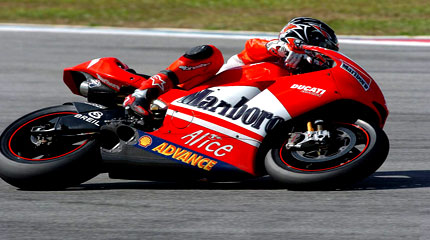
The systems of input from the rider are based on visual information as well as critical evaluation of feedback from the systems which affect the rider’s senses, primarily audible and vibrational. Feedback is vital to the performance of the machine because it acts as the nervous system in the body, acting as a mediator and interpreter for the road. The advanced rider is so much a part of the experience of the road that knee pucks are worn to allow the rider to slide his knee on the ground through turns in an effort to lower his center of gravity. In this way the motorcycle is acting as an artificial appendage which extends the capabilities of the human. When man integrates himself this fully with a machine the experience is out of body or more appropriately super-bodied, enhanced and enlivened.

The Architecture_
_Form follows Force_ dynamic forces have direct relation to the form and consequently the intended reaction of the system to that force.
_User Integration_ the user is the motorcycle and the motorcycle is the user. When separated neither system operates to the ability of the combined network. Super-bodied experience can be achieved.
_Framework_ a single spine facilitates the connection and orders the interaction of all the other systems in accordance to their performative duty and forces which inform them.
[i] “ducati 1098 bare,”
[ii] "Casey Stoner integrated" <http://www.gameguru.in/images/moto-gp-1.jpg>
Positive acceleration utilizes the engine, intake, exhaust and fuel systems. The exhaust and intake systems are aerodynamically tailored to provide the path of least resistance, allowing the engine to become more efficient. The engine itself is designed to control combustion energy and transfer it into rotational energy to propel the network.
Negative acceleration requires the engine in a reverse role for engine braking and the wheel braking system which is designed to put vast amounts of anti-rotational friction on a system directly linked to the wheels and tires. A system of holes in the brake rotors allows the system to ventilate itself to prevent wasted heat energy.
Lateral acceleration is controlled as much by rider weight transfer as by the handle bars which allow the bike to lean into turns. Throttle and braking also play an active roll in the suspension stability while turning. Motorcycles are at equilibrium while standing centered and so the rider must upset this equilibrium. The suspension moderates the upset chassis and keep the wheels in contact with the road. The suspension is designed react to the forces presented by the road as well as apply the forces of rider input towards the road while providing feedback to inform the rider.

[i]
Aerodynamics is important to the stability of the network which is capable of speeds near 200 miles per hour. The outer sheathing of the motorcycle is shaped by the aerodynamics studies of the human body in conjunction with the machine as well as the functional breathing requirements of the engine. Apertures in the skin coordinate with intake and cooling systems. Every material is scrutinized and each system is whittled to an optimum state to achieve peak performance. The complete network, including the rider, performs at a level beyond the sum of each aforementioned system.
The systems of input from the rider are based on visual information as well as critical evaluation of feedback from the systems which affect the rider’s senses, primarily audible and vibrational. Feedback is vital to the performance of the machine because it acts as the nervous system in the body, acting as a mediator and interpreter for the road. The advanced rider is so much a part of the experience of the road that knee pucks are worn to allow the rider to slide his knee on the ground through turns in an effort to lower his center of gravity. In this way the motorcycle is acting as an artificial appendage which extends the capabilities of the human. When man integrates himself this fully with a machine the experience is out of body or more appropriately super-bodied, enhanced and enlivened.

The Architecture_
_Form follows Force_ dynamic forces have direct relation to the form and consequently the intended reaction of the system to that force.
_User Integration_ the user is the motorcycle and the motorcycle is the user. When separated neither system operates to the ability of the combined network. Super-bodied experience can be achieved.
_Framework_ a single spine facilitates the connection and orders the interaction of all the other systems in accordance to their performative duty and forces which inform them.
[i] “ducati 1098 bare,”
[ii] "Casey Stoner integrated" <http://www.gameguru.in/images/moto-gp-1.jpg>
Subscribe to:
Posts (Atom)